Wheel alignment

Printed matter:

Eliminate the risks
- check the wheel angles on your vehicle!


It is not just the tires that get worn on a vehicle, it is much more than that. The examples below show several different causes and effects of incorrect wheel angles.
 
If a diagnosis in the workshop shows that a vehicle has incorrect wheel angles it will result in different consequences when the vehicle is driven on the road depending on what the problem is.

When it comes to tire wear and excessive fuel consumption, foresight is very important. By the time abnormal tire wear is discovered the damage is already done. A lot of energy has been consumed just for moving the tire footprints sideways on the road. Because of this it is important to check the wheel angles of your vehicle regularly.
 
Before carrying out a wheel alignment it is also important to fix wear and tear on bushes and bearings to get correct measurements.
 

The measurements indicate incorrect toe-angle. The front wheels veer in different directions.
Results:
• Bad steering abilities
• Longer braking distance
• The tires ”slide” sideways which results in mechanical wear in wheel suspension
• Increased rolling resistance - increased fuel consumption
• Abnormal tire wear


The measurements indicate rear axle out of square. The driver must parry the out of square by turning the steering wheel. The total vehicle width gets wider, typical dogrun.
Results:
• Hazardous vehicle because of increased width
• Increased drag gives increased fuel consumption
 

The measurements indicate rear axles out of square. The conflict between the rear axles’ forces F1 and F2 is transferred to the frame and results in the force R1. The resulting force R1 must be countered with the force CF1 by turning to the left.
Results:
• Hazardous vehicle with bad driving abilities
• Increased rolling resistance gives increased fuel consumption
• Mechanical wear and tear in suspensions
 

The measurements indicate out of square on the semitrailer. R1 is the resulting force of F1 and F2. R1 must be countered with CF1 and CF2 by turning to the right.
Results:
• Hazardous carriage with bad driving abilities
• Increased rolling resistance gives increased fuel consumption
• Mechanical wear and tear in suspensions
 
Tire wear on your vehicle has several reasons and consequences

As a preventive measure it is important to turn to an expert with the right competence and equipment to measure the wheel angles and optimize your vehicle so that:

• it avoids abnormal tire wear and fuel consumption
• it rolls straight on the road and avoids ”dogrun”
• it gets good steering abilities and shortest possible braking distance
• it avoids abnormal mechanical wear and tear

Another aspect is the driver’s way of driving. A jerky way of driving has of course great influence on tire wear and fuel consumption. ECO-driving is an important concept that the driver needs to take into account.

Tire pressure, way of driving and tire type are also important factors that affect the economy. Freeway traffic and urban traffic affects a vehicle in
different ways and results in different types of wear and tear. Therefore, it is also a good idea to contact a tire specialist for guidance on what kind of tires suits your vehicle the best.

JOSAM has the solution
- 40 years’ experience in wheel alignment


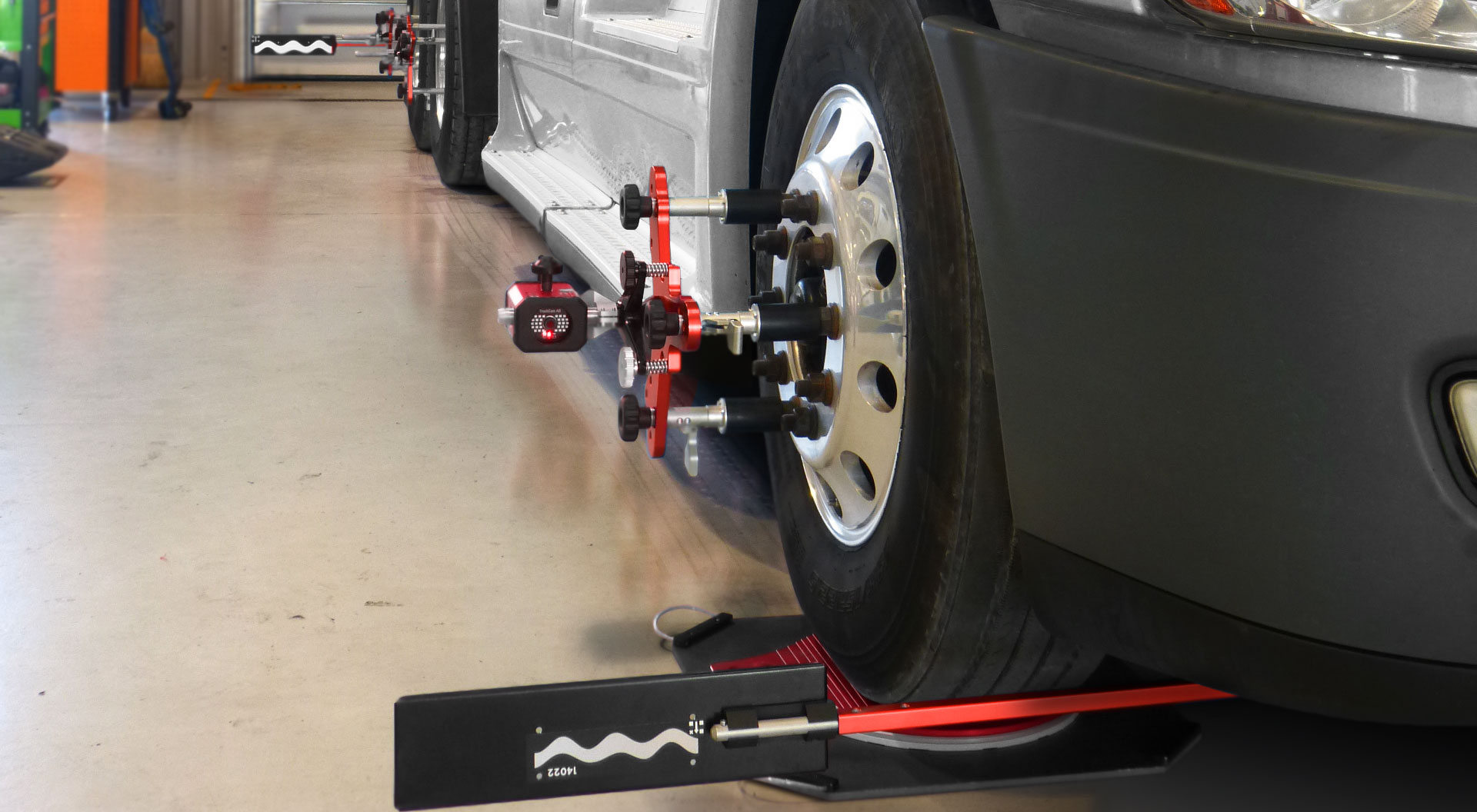
With JOSAM’s wheel alignment systems you can quickly carry out a diagnosis on your vehicle and find out if your wheel alignment is correct. A vehicle diagnose is carried out in just a few minutes. If the wheel angles need to be adjusted this can be done right away, or you can reserve a time for adjustment on a later occasion.

With JOSAM’s experience in wheel alignment and adjustment of heavy vehicles you can rest assured that your vehicle rolls straight and secure on the road. The JOSAM measuring systems of today are superior in speed, precision and safety which along with our 40 years’ experience makes JOSAM the obvious choice in wheel alignment for heavy vehicles.